By Amakhosikazi Media Southern Africa
The popularity of televised paternity revelations has created a powerful but troubling gender spectacle.
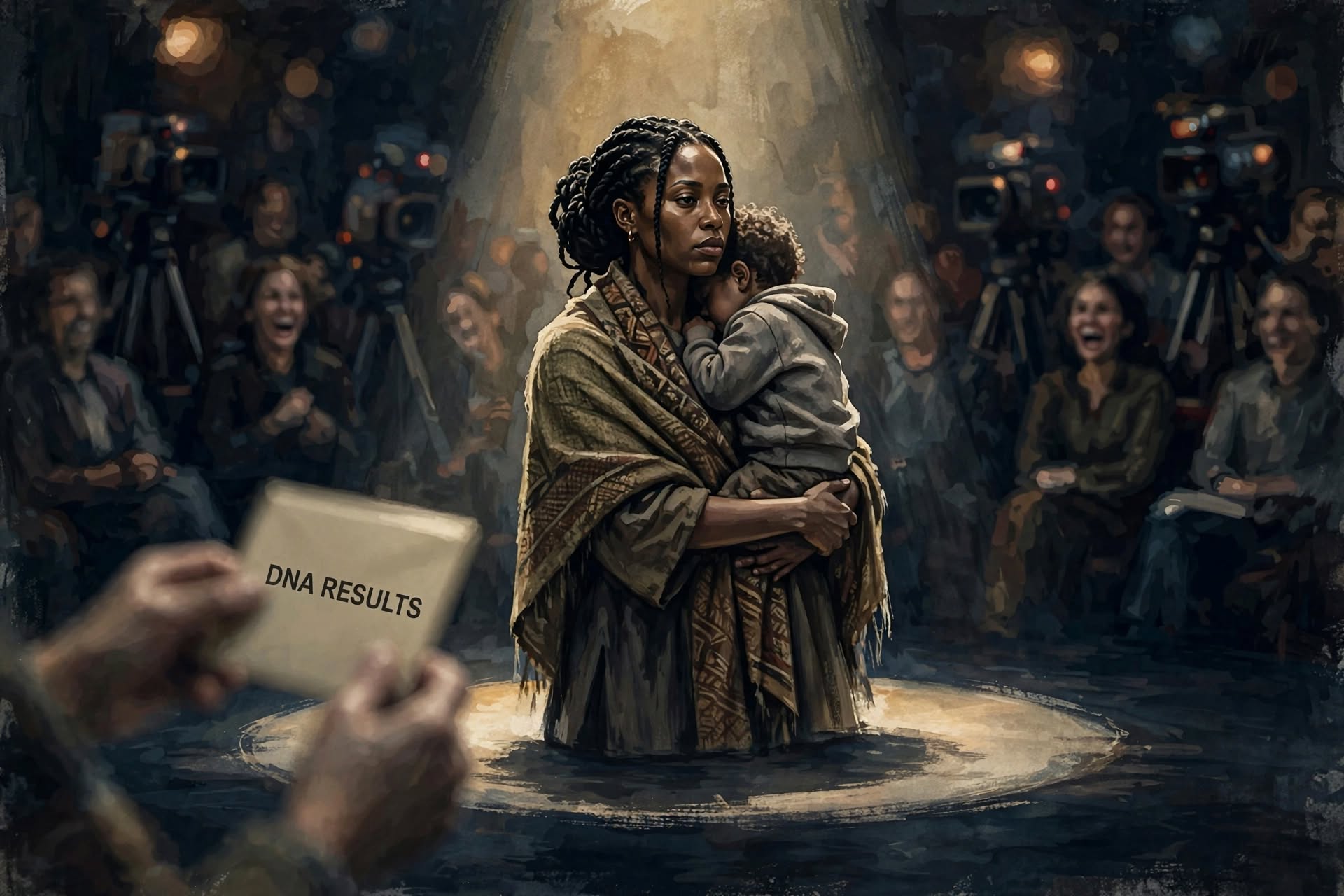
A man doubts paternity. A DNA test is done. The result is revealed before cameras. The nation has a “good” laugh at the outcome, much to the woman’s expense.
But the format does more than establish biological truth. It constructs a public trial in which the woman is cast as the accused, the DNA result serves as the verdict, and her humiliation becomes the entertainment.
The problem is not only what individual results expose. It is how the structure of the show itself positions women.
Judged before the envelope is opened
The arc is familiar. The man arrives with suspicion. The woman is confronted on camera. Her fidelity and credibility are questioned. Her reaction is recorded. Then comes the suspenseful wait.
Before the envelope is opened, the damage is done. She has already been publicly accused of sexual betrayal.
If the result confirms he is the father, does that erase the accusation? It does not. She has still been publicly suspected of infidelity. Viewers may remember the doubt, not the clearance.
If it excludes him, the stigma deepens into public shaming. Branded a liar, a cheat, a deceiver. The consequences follow her from the studio back into her community, church, workplace and her children’s schools.
There is no outcome in which she walks away untouched. The DNA answers a biological question. It cannot undo the public memory of the accusation.
After the cameras, the child remains
The audience moves on. The woman does not. Episodes are clipped, circulated and remembered for years.
And the child, who never requested a test and never consented to public exposure, becomes collateral damage. Whether the man is confirmed or excluded, the child may grow up knowing their family history was turned into a public climax.
The question Closure never asks: Why did she hide the truth?
This is the conversation DNA shows rarely have. When a father is excluded, the show stops at exposure. It seldom asks why the truth was hidden.
Not all cases are simple cheating, and even where infidelity is involved, we have to ask who we are to judge so selectively. There is no equality roster, no gadget that publicly displays all our infidelities. Men can and do cheat, often with the evidence literally carried away and raised in another household. Their infidelity rarely becomes a televised trial.
For women, the stakes are profoundly different in a culture where infertility is still almost automatically blamed on women.
In many communities, it is the woman who is sent away from her marriage for failing to produce an heir. It is the woman who endures the insults, the family pressure, the threat of divorce and destitution because a child has not come. Infertility investigations, where they happen at all, still start with her body. Male infertility remains largely unspeakable.
Under that pressure, some women make desperate choices that many would judge harshly, seeking pregnancy outside the marriage when faced with a husband who may be infertile, who refuses testing, or who has already fathered children elsewhere while she is held responsible for an empty womb.
This does not excuse deliberate deception. A man who unknowingly raises a child that is not biologically his suffers real emotional and financial harm, and he has every right to know the truth.
But to present every case through a single script, man as innocent victim, woman as automatic perpetrator of fraud, erases the structural coercion behind some of these deceptions.
When a society tells a woman her value is motherhood, blames her for childlessness, allows men to step out to have children with other women with impunity, and then publicly shames her when she steps out of the lines drawn for her, we have to ask whether we are interested in truth or simply in punishment.
Where men may choose to leave the home to father children elsewhere, many women feel they cannot leave and cannot fail to conceive. That unequal power to hide infidelity and to define infertility is precisely why a public trial will always punish women more severely.
Truth without a public trial
There is a legitimate conversation to be had about paternity fraud and reproductive honesty. Men should not be dismissed.
But there is also a legitimate conversation about why private pain must become public entertainment.
Private DNA testing exists. Counselling, mediation and legal processes exist. None require that a woman’s alleged infidelity, a man’s heartbreak and a child’s parentage become a national spectacle.
A responsible approach would consider consent, anonymity for children, psychological support, and what happens after broadcast. Because there is a profound difference between revealing the truth and punishing someone with it.
The format tells us who fathered a child. It does not tell us why a woman felt she had to lie, why a man was never asked to test his own fertility, or why his infidelities carry no equivalent public ledger.
Until we ask those questions, we are not just establishing paternity. We are enforcing a double standard, and making women and children pay the price for it long after the cameras stop rolling.