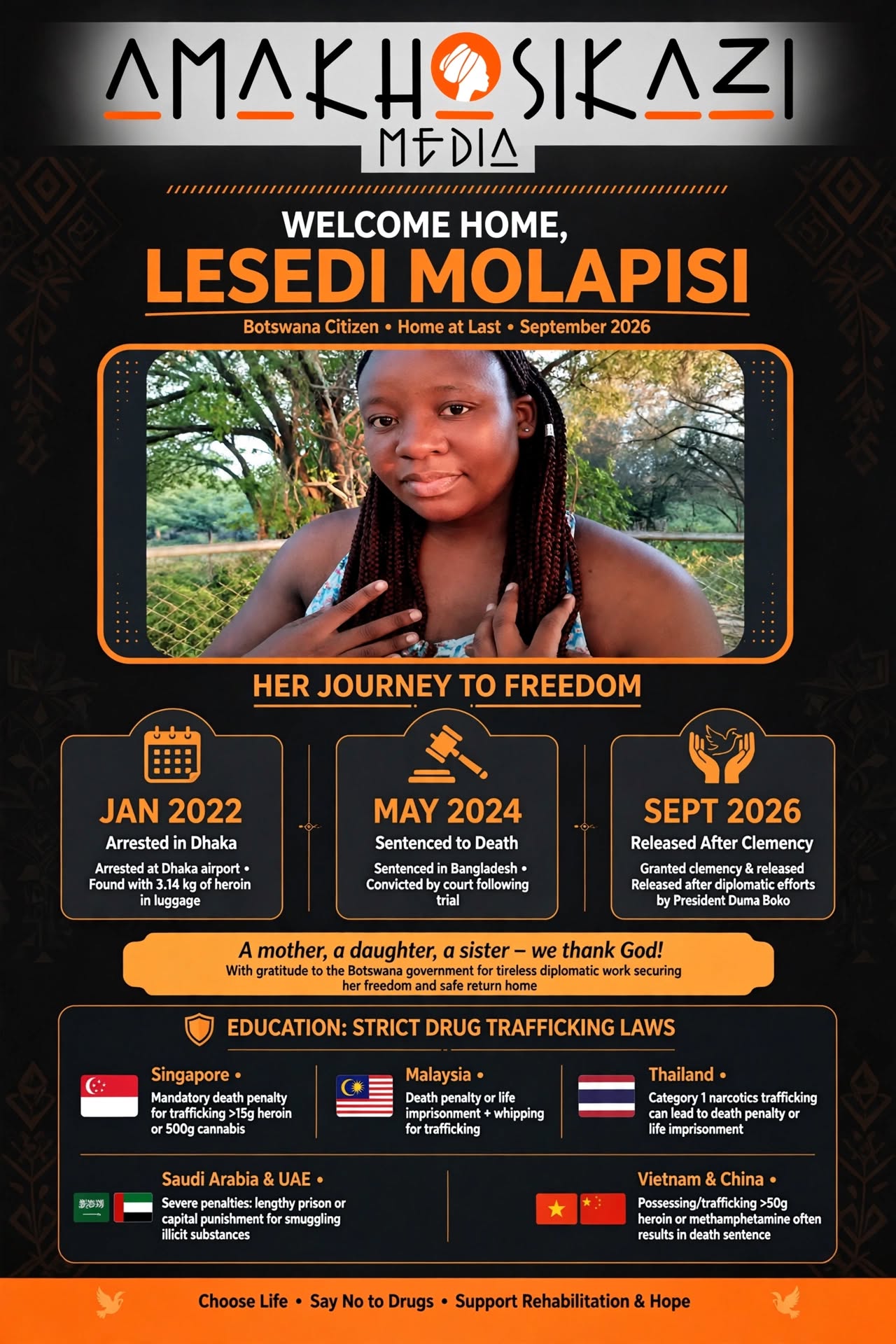
GABORONE — The dramatic release of Lesedi Molapisi from a Bangladeshi prison this month has sent shockwaves across Southern Africa. Her story is a rare tale of survival, but security experts warn it must serve as a stark reminder of the deadly risks facing young women targeted by international drug syndicates.
Molapisi, a 34-year-old Motswana woman, was arrested in January 2022 at Hazrat Shahjalal International Airport in Dhaka. Customs officials discovered 3.145 kilograms of heroin hidden in her luggage after she arrived on a flight from South Africa. By May 2024, a Bangladeshi court handed down a definitive sentence: death by hanging.
Her execution seemed certain until a massive, multi-year diplomatic intervention led by Botswana’s President Duma Boko and the Ministry of International Relations secured executive clemency. Molapisi’s sentence was commuted, and she was allowed to return home to her family—a miracle in a country known for its unyielding stance on narcotics.
A Rare Exception to an Absolute Rule
While Molapisi’s story ended with an embrace at the airport, she is the exception to a brutal global rule. Across Asia and the Middle East, drug trafficking carries mandatory capital punishment, and foreign governments rarely yield to external political pressure.
Region / CountryStrict Legal Consequences for Drug Trafficking
Singapore: Imposes a mandatory death penalty by hanging for trafficking more than 15 grams of pure heroin or 500 grams of cannabis.
Malaysia: Law carries the death penalty or mandatory life imprisonment with whipping for trafficking dangerous drugs.
Thailand: Trafficking Category I narcotics (like heroin or MDMA) can lead to the death penalty or life imprisonment.
Saudi Arabia & UAE: Smuggling illicit substances frequently results in beheading or prolonged maximum-security prison terms without parole.
Vietnam & China: Possessing or trafficking more than 50 grams of heroin or methamphetamine regularly triggers a death sentence.
Targeted for the “Quick Fix”
International syndicates systematically prey on young, financially desperate, or overly trusting women from Southern and Eastern African nations, including South Africa, Zimbabwe, Botswana, and Lesotho.
Recruiters use sophisticated tactics, often posing as successful businessmen, romantic suitors, or online recruiters offering lucrative “luxury travel” opportunities or jobs as international couriers. Victims are handed sealed luggage, beauty products, or electronics, and are promised quick cash upon delivery.
What these women rarely realize is that cartels view them as entirely expendable. In many documented cases, syndicates will deliberately tip off airport customs about a specific woman carrying drugs, sacrificing her to security forces so that a much larger shipment can pass through undetected at another terminal.
The Illusion of “I Didn’t Know”
The legal reality in foreign jurisdictions is unforgiving. International courts strictly adhere to the principle of strict liability: if the drugs are in your bag, you are guilty. Courts universally reject defenses like “I didn’t know it was there” or “I was just carrying it for a friend.”
For those caught, the price is catastrophic. Those who escape the death penalty face decades in foreign penitentiaries characterized by severe overcrowding, extreme language barriers, medical neglect, and complete isolation from their loved ones.
Molapisi’s survival is a diplomatic anomaly. For every mule who makes it home, dozens of others disappear into foreign prison systems or face the gallows alone. Security agencies urge young citizens to remember that no promise of quick money, luxury clothing, or easy travel is worth a lifetime behind bars—or your life.