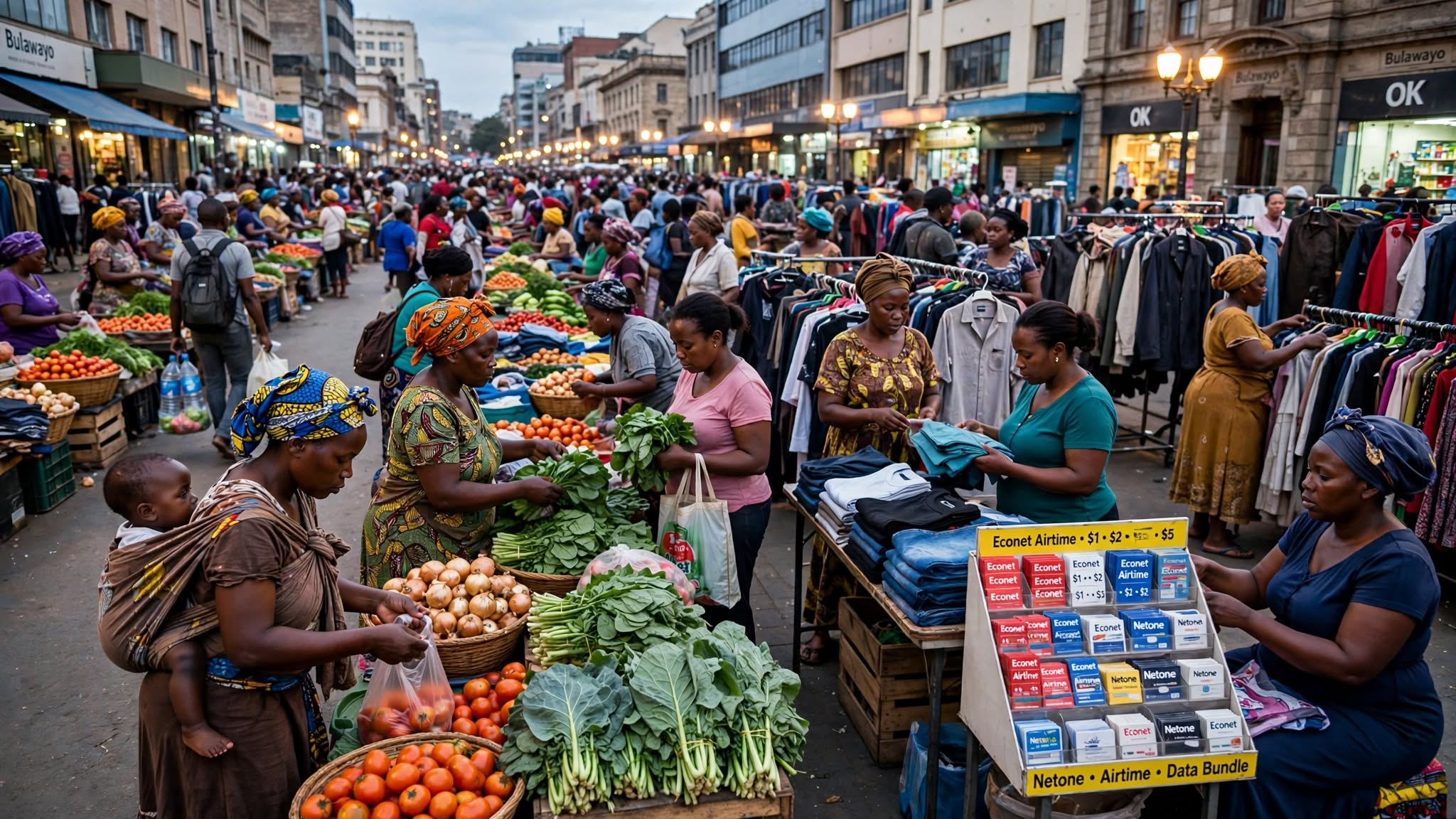
The Government of Zimbabwe says it wants clean, orderly cities. But the women who make up most of Zimbabwe’s informal workforce are paying the highest price for getting there. They are also among the people paying the councils’ bills.
On 17 September, Permanent Secretary Tafadzwa Muguti announced that vending in all central business districts would be limited to 6am–6pm, and vending in residential areas, including high-density suburbs, to 6am–8pm. The rule applies across all 92 local authorities and took effect immediately. It came days after Operation Chenesa Harare saw stalls torn down in the capital. The government then softened its earlier demand for a complete CBD clearance in the face of vendor resistance. In Gweru, vendors were ordered out of the CBD and warned of confiscation of goods and prosecution.
The government’s case deserves a fair hearing. Congested pavements, poor sanitation and blocked shop entrances are real problems, and Bulawayo’s Town Clerk has said as much. Formal businesses that pay rates and licences have a legitimate grievance when trade spills onto the streets. The directive, officials stress, applies to legally registered vendors in designated sites and does not regularise illegal trading. No one disputes that cities need rules. The question is who pays for enforcing them.
An informal trade with a woman’s face
Zimbabwe’s informal economy is the country’s real labour market. ZimStat’s third-quarter 2024 survey found that 58.1% of employed women worked in the informal sector. Advocacy and research sources put women at roughly two-thirds of the informal workforce. The Zimbabwe Chamber of Informal Economy Associations reported in 2020 that about 60% of its roughly 200,000 members were women. An ILO situational analysis found that about 63% of the women in its sample were fruit and vegetable vendors, which it attributed to the ease of entry and low start-up capital the work requires.
Those are also the lowest-paying corners of the informal economy. The same ILO analysis found that 61.3% of women in the informal economy earned below US$100 a month, and that men’s weekly mean incomes were roughly triple women’s. In Bulawayo, a study of vendors in Makokoba and Nguboyenja put average monthly incomes at $164–$190, far below the $481 consumption poverty line, for households that averaged four people. National figures tell a similar story. ZimStat’s first-quarter 2024 survey found that 83.4% of employed people took home less than US$362 a month, and 34.4% earned under US$90.
For many women, trade is what stands between a household and hunger. It pays for food, rent and school fees. A 2020 commentary reported that about half of women entrepreneurs in the sector were their families’ main breadwinner. Many are single mothers, for whom vending hours are built around childcare and school runs.
Women who pay their way
The picture of vendors as people who take from the city and give nothing back does not survive a look at the paperwork. Under Bulawayo’s hawkers and vendors by-laws, a vendor’s licence application must be accompanied by the appropriate fee, and anyone wanting a bay, table or stall in a people’s market must apply for a licence and pay a fee fixed by council. One consultancy’s indicative 2025 figures put vendor and market fees at roughly US$5 to US$20 a month. That is small for the council but is a real cost to a woman netting a few dollars a day. Bulawayo’s own councillors accept that vendors want to be part of the system. Ward 9 councillor Donaldson Mabuto said his research found vendors and small operators willing to pay council, but stringent bylaws and inflexible procedures obstruct them.
Vendors also pay the national tax authority. Hair salons and other small vendors pay a presumptive tax, a simplified tax the government introduced to collect revenue from the informal sector as formal wage jobs disappeared. The same report records a sharp division over its fairness. Advocacy groups for women, who mainly make up the informal sector, argue it is unfair to chase revenue from a tiny source when far larger sums are lost through corruption, and VISET’s Ruvimbo Chidakwa said the presumptive tax harms women-owned businesses. A 2024 study of Harare and Masvingo adds that women are more tax compliant than men and less likely to pay bribes.
The state is now tightening the link between vending and tax. In August, Finance Minister Mthuli Ncube proposed tying the renewal of council licences for vendors and small businesses to tax compliance, with ZIMRA and local authorities sharing information through integrated online platforms. Government is therefore asking women vendors to prove they have paid their taxes in order to keep their licences. At the same time it is shortening their trading day and moving them away from their customers. Income that is meant to fund those payments is the income the new rules put at risk.
Where the new rules bite
The first blow is the hours. Commentators have noted that 6pm is not the end of the trading day for every vendor. Commuters buy vegetables, airtime and cooked food on their way home from work, and a woman who sells in that window loses her best hours. Residential trading until 8pm softens the blow for some, but it moves trade away from the city-centre foot traffic that sustains many stalls.
The second is space. Bulawayo City Council’s June 2026 surveys counted about 4,100 vendors in the affected areas, and the Town Clerk has said Bhaktas can accommodate about 2,000. An earlier council count found 3,416 CBD bays, nearly all occupied. Bays exist, but they are not evenly distributed, and traders have long complained about poor foot traffic at designated sites. A VISET survey found that traders relocated from the city centre two years earlier were still waiting for bays.
The third is paperwork. Council’s own figures show only 244 of about 3,300 bay-holders held licences. Holding women to a compliance standard the system makes hard to meet is a policy failure, not a moral one, and it is hard to reconcile with a demand that they prove tax compliance to keep their licences.
The last is enforcement itself. For a vendor living on a few dollars a day, goods seized in a raid can wipe out weeks of working capital. The savings clubs many women rely on, where members borrow small sums weekly to restock, collapse if the stock is gone. Children feel it in the next school term.
Who pays the bills when the stall closes?
Council depends on household money, and a great deal of that money is earned on the pavement. Bulawayo City Council has been open about its cash-flow problem. Its 2025 report shows it billed ZiG3 billion and collected ZiG1.9 billion, a collection efficiency of 65%. By this year’s mid-term review it had billed ZiG1.8 billion against a target of ZiG2 billion, and collected ZiG1.3 billion by 30 June. Residents account for 71% of a ZiG2.7 billion debtors’ book. Council says the shortfall limits its ability to buy equipment and maintain water and sewer infrastructure, and water and sanitation take the largest share of its proposed 2026 budget.
Behind those numbers are households. Fixed charges for water, sewerage, refuse and rates apply even in weeks when no water comes through the taps, and the council warns defaulters of legal action, including the possible confiscation of homes. For a woman who sells tomatoes or second-hand clothes, the rates bill, the stall fee, the tax payment, the school fee and the evening meal all come out of the same small daily float. A vendor earning US$164–US$190 a month in a household of four cannot pay council while her stall sits idle. She will cut back on food or school costs, or fall into arrears. Each woman pushed out of trading is a household likely to fall behind on council bills, which works against the revenue council says it needs.
The clampdown also hits council’s own income directly. Vendors pay for bays and licenses, and Mayor David Coltart has said that more designated bays could raise the number of licensed vendors from 12,000 to 15,000 and lift revenue. Chasing vendors off the streets without a place to trade cuts the very revenue base the council is trying to protect.
A fairer path
Nothing here argues that cities should tolerate chaos. It argues that order built on the livelihoods of the poorest women will not last, because people who cannot eat will return to the pavement. Councils and government could make the rules work by building and licensing before removing, with enough bays in places with real customers and licenses that are affordable and quick to obtain. They should consult the Bulawayo Traders and Vendors Association, VISET and ZCIEA, who are already at the table, before hours and sites are fixed. Enforcement should be proportionate, so that seizing goods is not the first response to a woman whose only offence is trading where no bay was offered.
Bulawayo’s vendor register should record how many traders are women, so that policy rests on evidence and not assumption. And before enforcement, authorities should count the cost of thousands of households that can no longer pay their bills, fees and taxes. A city’s cleanliness is worth defending, and so is the dignity of the women who feed its households.