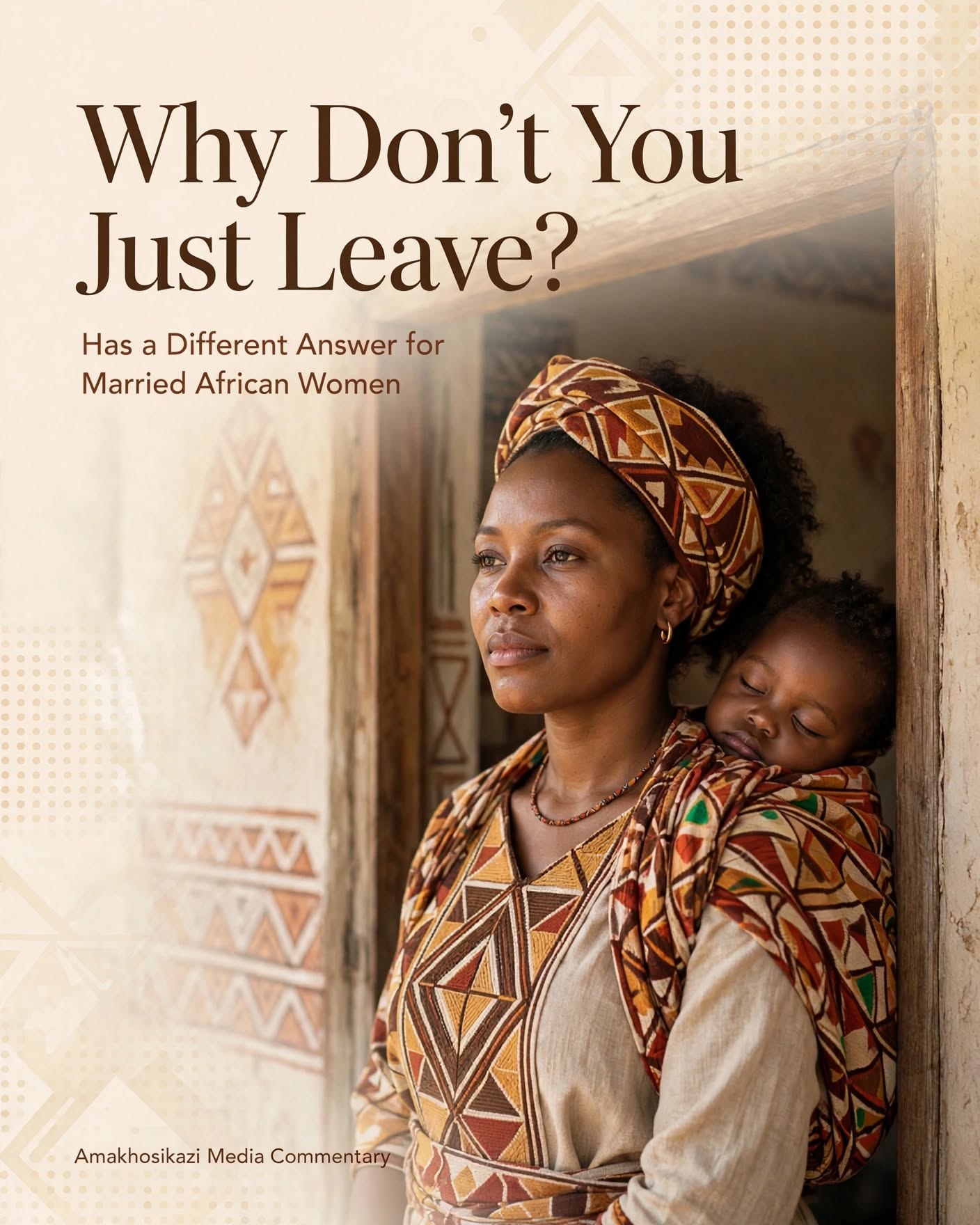
By Amakhosikazi Media Commentary
“Why don’t you just leave?”
In conversations about troubled marriages, abuse and intimate partner violence, it is often the first question asked of a woman.
But in many African societies, that question does not carry the same weight for women as it does for men.
For a man, leaving can be painful and complicated. For many women, leaving can mean walking away from far more than a husband, from identity, social standing, economic security, family structure, and often the only adult life she has known.
At the heart of this is a cultural expectation: “Umuzi ngumfazi”, the woman makes the home.
The responsibility for keeping the marriage together falls disproportionately on her. She is expected to nurture the children, care for her husband, keep the peace and ensure the marriage survives at all costs.
Society rarely tells a man with the same intensity that “umuzi yindoda.”
When a marriage collapses, the woman is asked what she did wrong. Did she respect him enough? Did she take care of him? Why couldn’t she hold her family together?
Even when she is not responsible for the breakdown, she carries the blame.
When a Childhood Mistake Becomes a Lifelong Sentence
Not every marriage begins with two people freely choosing each other.
In some African cultures, including Shona and Ndebele communities, when a young girl becomes pregnant, the response is often to send the boy and girl into marriage. The logic is familiar: the pregnancy creates responsibility and marriage is seen as the honourable solution.
But teenage pregnancy does not mean compatibility, emotional readiness, or commitment. It does not mean they would have chosen each other.
A mistake made in childhood can become a lifelong sentence.
We must separate parenthood from marriage. A young man should take responsibility for his child. A young woman should be supported through motherhood. Both families should ensure the child is cared for. But two young people can be responsible parents without being suitable life partners.
When families force marriage for the sake of honour or stability, resentment often grows. The couple matures apart. Yet by then there are children, in-laws, property and decades of history binding them.
And when problems start, the same families who insisted on the marriage often go silent about their role. The woman is told to persevere, to respect her husband, to think of the children.
Rarely does anyone ask: Were these two young people ever ready for marriage? Rarely is it acknowledged that the marriage was born of pressure, not choice.
The burden falls heaviest on the girl. Her childhood ends. She becomes a wife, daughter-in-law and mother while still trying to understand herself. If the marriage later fails, society sees a failed wife, not the frightened teenager who was sent to another family because she became pregnant.
Children need responsible parents and a safe environment. Those things can exist whether parents are married or not. What children should not inherit is the belief that their existence requires their parents to remain trapped.
“Umabuya ekwendeni” AKA “Returning Soldier”: When Divorce Becomes Identity
Among isiNdebele speakers, the phrase “umabuya ekwendeni”,a woman who has returned from marriage — carries a derogatory weight for divorced women.
There is no equivalent label that follows a divorced man in the same way.
She stops being a woman who experienced a failed marriage and becomes “the woman who came back.” The label affects how she is perceived. Some suitors hesitate not because she is not desirable, but because society has taught them to see a divorced woman, especially one with children, as less worthy.
The language becomes crueller when she is treated as “second-hand” compared to a never-married woman.
A woman does not become less human or less deserving of love because a marriage ended. Her value cannot be measured by whether she has been married before.
The double standard is clearest at remarriage. A divorced man with children can marry a younger, never-married woman and be welcomed by her family. But when a divorced woman with children enters lobola negotiations, her history is often used to suggest she is of lesser value.
If a man’s previous marriage does not reduce his value, why should a woman’s? People are not products. Marriage is not a manufacturing process where value depreciates with use.
This is one reason some women stay in unhappy marriages. It is not always weakness. It is a calculation of the social, financial and emotional cost of leaving — especially when a husband who shared her best years decides to start over with a younger woman. Society gives him freedom to start again while telling her that her age and children are liabilities.
When His Family Becomes An Accomplice
One of the most painful experiences is discovering that the husband’s family is not neutral.
In some cases, relatives know about his infidelity and quietly support it. They help maintain the other relationship, facilitate meetings, even participate in secret lobola negotiations for another woman while his wife is still in the home.
For a wife who bore children, supported relatives and respected traditions, the betrayal feels collective. The message is: you have served your purpose.
This is devastating in cultures where marriage is a union between families, not just individuals. If a family claims the right to intervene to establish a marriage, it must also accept responsibility when that marriage is in crisis. It cannot demand she be a loyal makoti when needed, then abandon her when their son wants another woman.
There is a particular cruelty in being replaced before the marriage has formally ended, still cooking, raising children and attending family functions while discussions about her replacement happen behind her back. She is physically present but emotionally evicted.
If a marriage has irretrievably broken down, the honourable approach is honesty and a dignified separation, not secret arrangements.
Expected to Become Caregiver Again
There is a further reality families must confront: what happens when the man who left becomes sick?
Stories abound of men who leave their matrimonial homes for another woman. The first wife remains, often raising children and rebuilding her life. Years later, the man becomes seriously ill in the home of the woman he a.
Suddenly, the family remembers the first wife.
“He is still your husband. You cannot abandon him now,” she is told.
But where is the fairness? When he wanted companionship, he left. When he wanted another woman, his family supported him. When illness comes, the first wife is expected to reclaim the duties of marriage.
Compassion for a sick person is necessary. But compassion is not entitlement. A former wife may choose to care for him out of humanity, shared history, or for their children. That must be her choice, not an obligation imposed by relatives who were absent when she carried the burden of abandonment.
And if the second relationship was legitimate enough to receive family support, why is it suddenly unsuitable to provide care when he is ill? If society recognises a man’s right to leave, it must also recognise that leaving has consequences.
A woman’s care is a gift, not a debt. Forgiveness is not reconciliation. Caring is not consent to become a wife again.
We Must Change the Question
If we want to prevent domestic violence and family breakdowns, we must understand the pressures around these relationships rather than simply judging the final outcome.
We should not only ask, “Why didn’t she leave?” We should ask:
Why was leaving made so difficult for her? Why is a divorced woman judged differently from a divorced man? Why is a woman who leaves gossiped about while a man who leaves gets a fresh start?
When leaving means losing her home, financial stability, social standing and hope of being loved again, many women will endure what they should never have to endure.
Where there is violence or a threat to safety, protection and support must come first.
Beyond that, we need to build a society where leaving a failed marriage does not mean becoming a social outcast. A mother should not wonder whether having children makes her less worthy of love. A woman should not have to remain married to avoid being called *umabuya ekwendeni*.
Umuzi ngumfazi cannot mean a woman alone is responsible for keeping a home together. A home is made by two people. Respect is mutual. Responsibility is mutual. Accountability must be mutual.
The real question is not “Why doesn’t she just leave?”
It is: “What would it take to build a society where a woman can leave an unhealthy marriage without losing her dignity, her security, her identity, and her hope of being loved again?”
Until we answer that honestly, telling African women to “just leave” will remain far easier than understanding what leaving actually means.