By Amakhosikazi Media Reporter
BULAWAYO — September 21, 2026
For decades, women in science, technology, engineering and mathematics have had to fight not only for opportunities, but for visibility. At the National University of Science and Technology (NUST), the numbers are beginning to tell a different story.
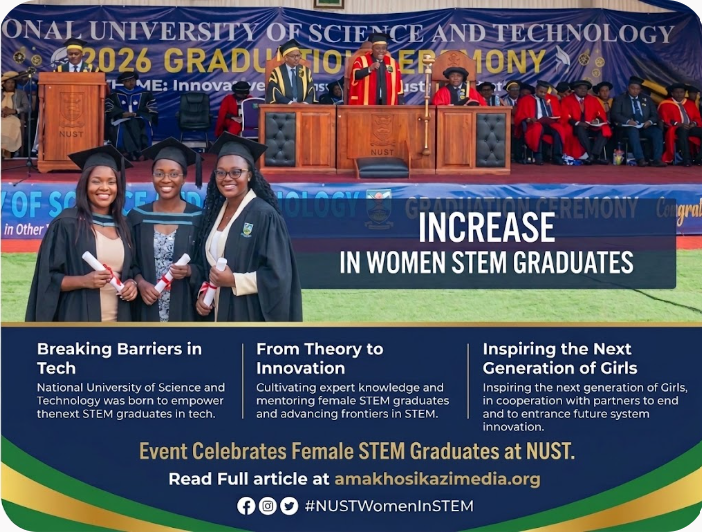
Women make up 52 percent of students admitted in the August 2026 intake, according to figures presented at the university’s 32nd graduation ceremony last week. Female participation across the university has risen from 46 to 47 percent, and women accounted for 1,208 of the 2,570 graduates capped at the ceremony.
The figures may look incremental, but they point to something larger: a changing picture of who is entering Zimbabwe’s scientific, technological and innovation pipeline. For a university whose graduation was held under the theme “Innovative Graduates, Industrial Futures,” the growing presence of women could become one of the most consequential elements of that future. (Herald Online)
From being counted to being seen
The story of women in STEM is not simply about numbers. It is about who gets to design buildings, develop technologies, conduct research, create businesses and ultimately influence the direction of a country’s development. It is also about the young girl in a classroom somewhere in Zimbabwe who needs evidence that science is not a man’s world.
At NUST, that evidence is becoming increasingly visible. Of the 2,570 graduates capped last week, 47 percent were women, and 68 percent of the graduating cohort received STEM-related qualifications. Overall enrolment has grown from 11,432 to 13,352 students. (Herald Online)
The latest intake is perhaps even more significant. For the first time in the figures reported around the 2026 graduation, women are a majority of new students. The next generation entering NUST begins with a gender balance that would have been hard to imagine when women were 46 percent of the student population.
The women behind the numbers
Numbers show progress, but people give it a face. One of the most striking examples from the 2026 graduation was Nomagugu Precious Ngwenya, a Bachelor of Science Honours graduate in Applied Biology and Biochemistry.
Ngwenya did not merely graduate. She secured 29 First Class passes out of 35 modules and a weighted aggregate of 84 percent. She was named NUST’s Overall Best Female Undergraduate Student and received the Chancellor’s Award for the Overall Best Graduating Student in the Faculty of Applied Science, along with the ZIMDEF Prize for Best STEM Female Graduand in the same faculty. (Herald Online)
Her achievement matters because of what it represents beyond her individual success: women are not simply entering scientific disciplines; they are excelling in them. A girl considering biological sciences, engineering, information technology or another traditionally male-dominated field now has more women she can point to and say: “She did it. I can do it too.”
From graduation gowns to innovation
The changing gender picture is unfolding alongside a broader shift in NUST’s approach to STEM education. Vice-Chancellor Professor Mqhele Dlodlo told the ceremony that the university was increasingly translating academic expertise into practical solutions, with students and graduates producing innovations recognised nationally, regionally and internationally.
Among those highlighted was Bridget Sibanda, whose emergency-response start-up, Beelifeline Private Limited, was selected for presentation at VivaTech 2026 in Paris. (ZBC News)
Sibanda’s story expands the definition of what a successful female STEM graduate can become. She is not simply a student who passed examinations. She is an innovator, an entrepreneur, a problem-solver and potentially an employer. This is the kind of transition Zimbabwe needs if greater female participation in STEM is to translate into wider economic participation.
“Turn knowledge into solutions”
Addressing the Class of 2026, Vice Chancellor, Proffessor Mqhele Dlodlo placed responsibility on graduates to take their education beyond the university gates. “Today you graduate not only with degrees but with the responsibility to shape Zimbabwe’s industrial future,” he said, urging them to “turn knowledge into solutions, innovation into enterprise, and challenges into opportunities.” (ZBC News)
For female graduates, that message carries an added dimension. They are entering spaces where decisions about technology, infrastructure, agriculture, health, energy, manufacturing and environmental sustainability are increasingly made. Who designs the solutions can shape whose needs those solutions recognise. A woman engineer may see an infrastructure problem differently. A woman scientist may ask different questions. A woman entrepreneur may spot an unmet need affecting women and girls that others have overlooked.
Greater representation does not automatically guarantee different outcomes. But without it, those perspectives are less likely to enter the room at all.
The importance of role models
For young women contemplating STEM careers, the journey begins long before university. It begins with teachers who tell girls that mathematics is for them, parents who support daughters who want to become engineers or scientists, and universities that create environments where women can thrive. And it continues with visible role models.
This is why Ngwenya’s achievements matter beyond the awards ceremony. Her 14 awards and exceptional record offer a powerful counter to the persistent perception that certain disciplines are naturally better suited to men. (Herald Online)
The challenge now is to ensure that exceptional women do not remain exceptions. The ultimate measure of progress will be a STEM environment in which female excellence is no longer remarkable simply because the achiever is a woman.
The unfinished journey: getting girls through the door is only the beginning
NUST’s progress should be celebrated, but it should also be interrogated. Getting more young women into university is one achievement. Keeping them there until graduation is another. Getting them into, and keeping them in STEM careers, where they shape the direction of science and technology, is another.
For many young women, particularly those from disadvantaged backgrounds, the journey through higher education is rarely determined by ability alone. Fees, accommodation, transport, food, learning materials and family responsibilities can bring an otherwise promising academic path to an abrupt end. When a young woman drops out of an engineering or science programme because of circumstances beyond her control, the loss is not only hers. The country loses skills, innovation, entrepreneurship and leadership.
So the question raised by the 52 percent intake is not only how many girls are entering the university. It is how many will make it to graduation. And beyond graduation: how many will enter STEM careers, start enterprises, conduct research, patent innovations, become professors, lead laboratories, and rise to become chief engineers, technology executives or science policymakers? These questions will determine whether increased female participation at university becomes increased female power in Zimbabwe’s knowledge economy.
Building a future where women are creators, not just consumers
NUST is also expanding its research and innovation agenda, with work in medicinal cannabis research, mineral beneficiation, agro-industrial development and geothermal energy. Its Bulilima agro-industrial project is reportedly 95 percent complete, and NUST and ZESA are exploring geothermal energy at more than 30 natural hot springs around Zimbabwe. (ZBC News). These are precisely the emerging fields in which today’s female students could become tomorrow’s scientific leaders.
Imagine women who are not merely consumers of technology developed elsewhere, but who design Zimbabwe’s technologies. Women who do not just work for agricultural enterprises, but engineer the systems that make them productive. Women who are not only patients in healthcare systems, but develop the biomedical research that improves them. Women who are not simply users of artificial intelligence, but build the systems and policies that govern it. That is the bigger promise contained in a 52 percent female intake.
An investment in women is an investment in Zimbabwe
The responsibility for realising that promise cannot rest with the university alone. The growing number of women entering STEM is an invitation to government, business, alumni, development organisations, communities and individuals to invest in their journey beyond admission.
NUST has recognised that access must be matched by support. Its Work for Fees programme lets students contribute towards their fees while gaining practical experience, and fundraising around the Vice-Chancellor’s Scholarship Fund aims to help students whose circumstances might otherwise prevent them from finishing. These initiatives matter most for female students from disadvantaged backgrounds, for whom financial and social barriers compound the challenges of higher education.
A scholarship can keep a student in the lecture room. A contribution towards accommodation can prevent a dropout. Support for learning materials can mean the difference between struggling and succeeding. Mentorship can help a young woman navigate a profession in which she may still be in the minority. An internship can turn a qualification into a career. The Vice-Chancellor’s Scholarship Fund and other student-support initiatives give society a direct way to help keep talented young people in higher education.
This is where the 52 percent figure acquires its deeper meaning. It is not just a statistic celebrating how many women have entered NUST. It is a responsibility. Every girl who enters a STEM programme represents years of investment by her family, teachers, community and the university. Helping her reach graduation protects that investment and multiplies its return, for her and for the communities and industries she may one day serve.
The future we choose to build
NUST has shown that it is possible to raise female participation, and its reported movement from 46 to 47 percent across the university, and to 52 percent in the August 2026 intake, is meaningful progress. But the real success story will be written several years from now: in women who walk across the graduation stage having overcome financial, social and logistical barriers; in women who become engineers, scientists, entrepreneurs, researchers and academics; in women who lead laboratories, companies and research institutions; and in the girls watching them, understanding that STEM is not a place they are merely allowed to enter, but one where they belong, can excel and can lead.
For that to happen, society must do more than applaud the numbers. We must help sustain them. The young woman struggling today to complete an engineering or science degree could be the researcher who develops tomorrow’s life-saving innovation, the entrepreneur who creates hundreds of jobs, or the engineer who designs infrastructure that transforms communities.
The question is not simply whether Zimbabwe can afford to support these young women through university. It is whether we can afford not to.
The laboratory door is opening wider. Now we must make sure the young women walking through it have the support to stay the course, graduate, innovate, lead and help build the Zimbabwe we all hope to see.