Commentary
By Amakhosikazi Media Southern Africa
South Africa 21 September 2026
In one week, South Africans have been shown two faces of the same problem. The first is the discovery of women’s bodies dumped along roads and open ground east of Johannesburg. The second is a video of a wealthy man cornering women in a restaurant bathroom and threatening to kill them for refusing him. One is a story of death and the other a story of a threat, but both rest on the belief that a woman’s “no” can be met with violence, and that she can be made to disappear.
The women of Ekurhuleni
Nine women have been found dead in the Ekurhuleni municipality since 17 July. All were believed to be in their 20s or 30s, some were found naked or partially clothed, and some bodies showed similar bruising. The first five were found in or near Kempton Park, and the others were discovered 25 to 35 kilometres away. Only four of the nine had been identified at last report. That means five families may still be waiting for a name.
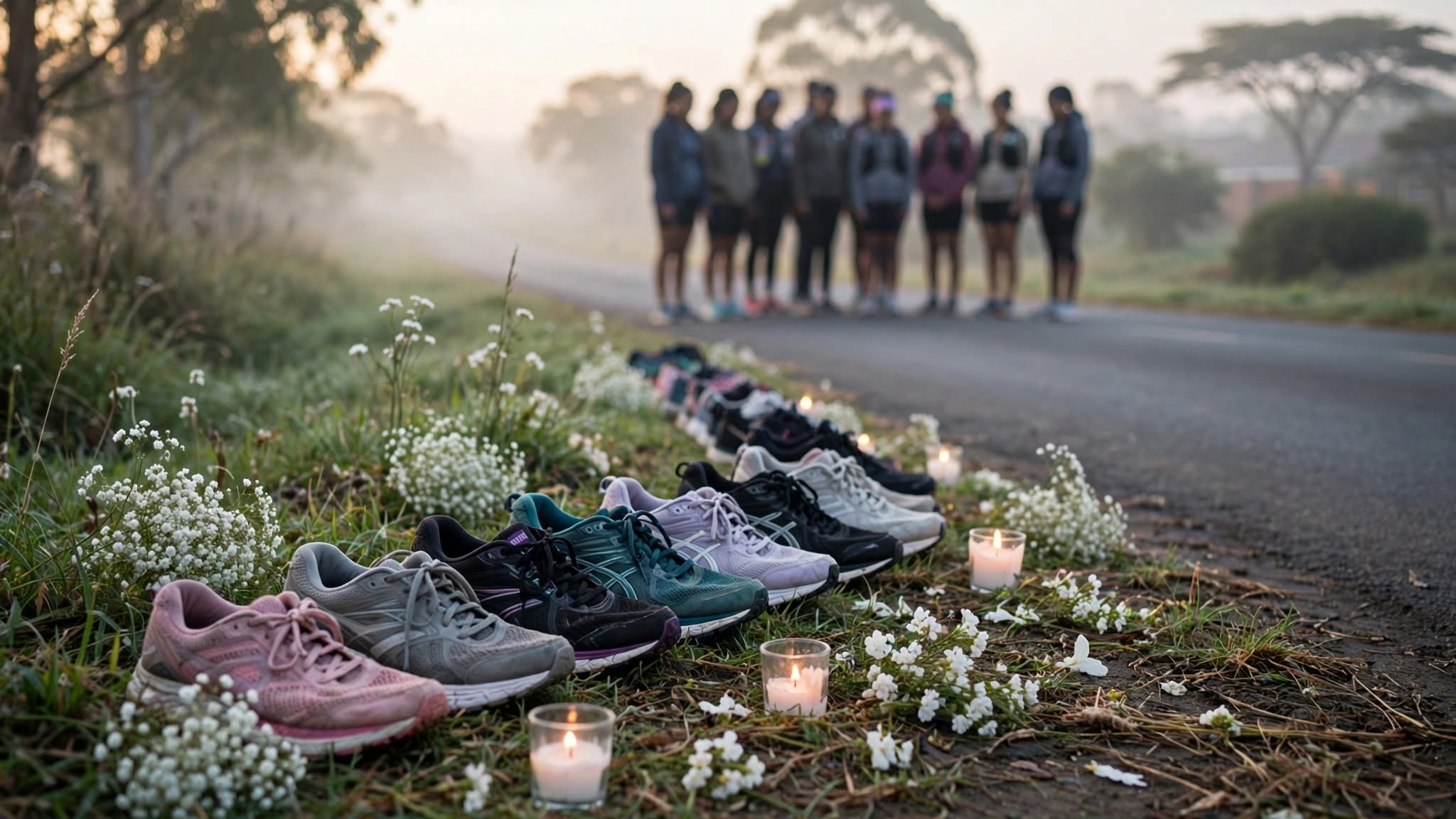
The case that broke the silence was that of 38-year-old Elizabeth “Tsontso” Moselakgomo. She left home for an afternoon run on 10 September, and her eight-year-old daughter raised the alarm when she had not returned by about 6.30pm. Her disappearance drew attention after fellow runners started a social media campaign, and the search led to the discovery of more bodies. Her family described her as “the glue of the family.”
Police have cautioned against calling this the work of a single perpetrator, saying they are also considering multiple suspects or separate offenders. That caution is proper. But the question of whether one man or several are responsible matters to detectives more than to the argument here. Women in South Africa did not begin dying violently this July.
The numbers were always there
The latest national statistics show 5,427 murders between April and June 2026, a 5.9% fall on the same period last year. The verified number of women murdered was 569, and another 1,052 women survived attempted murder. Of the 9,201 rapes recorded in that quarter, 8,814 involved women and children. By simple arithmetic, 569 killings over a 91-day quarter is roughly six women every day.
Two details complicate the picture. The first is the comfort of falling national figures. Research by the Medical Research Council found that femicide in South Africa more than halved between 1999 and 2020/21. That is real progress, and it should be acknowledged. But Parliament has said the country’s femicide rate is five times the global average. Falling from an extreme level does not make a country safe.
The second detail is that the state does not seem to know its own numbers. SAPS recorded 5,181 murders between January and March 2026 but did not publish how many of the victims were women. For 2023/24, researcher Lisa Vetten notes, one SAPS presentation recorded 5,578 women murdered, while the quarterly reports added up to 3,839 and the annual report gave 3,485. A country that cannot agree on how many women it has lost cannot credibly say it is protecting them.
Nor is the danger only on lonely roads. More than 60% of a sampled group of rape cases occurred at a residence. Women are being told to avoid running alone, but for many the threat is inside the home.
“I’ll murder you now and walk”
The Sandton incident is different in scale but not in kind. The confrontation at Vlamo restaurant in Sandton Gate reportedly began after the women rejected the man’s romantic advances. In the footage, he is heard saying he would “murder you now and walk” and was recorded threatening the women inside the women’s restroom. He also allegedly boasted of his wealth and dismissed the women as poor.
The businessman, identified in reports as Lawrence Mudzinganyama (spellings vary), has since apologised. Police confirmed an intimidation case was registered at Randburg police station on 19 September, and that he was arrested on 20 September and released on warning to appear in court on 1 October. His landlord terminated his lease, and the infrastructure company he chaired removed him from his positions. Two ministers have ordered probes into the company’s state contracts and credentials. He is a Zimbabwean national, according to the government’s justice cluster, a reminder that this is a regional problem and not one confined to a single country.
The consequences were swift and, in this case, deserved. But look at what triggered them: the women kept recording, and the video went viral. Accountability arrived because there was footage and public outrage. For every woman threatened without a camera or an audience, no probe follows and no lease is cancelled.
What has government done?
The record has real entries. Gender-based violence and femicide were declared a national disaster in November 2025. A National Council on GBVF was appointed in August 2026. After the Ekurhuleni discoveries, the Inter-Ministerial Committee approved a Comprehensive Emergency Strategy and elevated the investigating team to be coordinated by the Deputy National Commissioner for Detective Services. Three suspects, a man and two women, were arrested over the weekend in connection with the murder of Jabulile Ntimba, whose body was found in Dawn Park. Three constitutional bodies have also scheduled an inquiry into the criminal justice system’s handling of GBVF from 28 September to 2 October.
Speaking on Monday, President Ramaphosa accepted responsibility. He promised “more money, more resources, more technology” and said women should never have to live in fear of men.
The trouble is the gap between announcement and delivery. Vetten says she has seen no new funding reaching the shelters and victim-support services she works with in Gauteng, and that the number of shelters has declined despite the disaster declaration. She argues the problem lies in the administration of the state: how budgets are spent, whether departments have competent staff, and whether the justice system has the capacity to respond. Nearly a year into the declaration, frontline organisations still report serious resource problems. And Vetten argues that GBV is a chronic condition, not a temporary emergency like a flood. A disaster response that fades once the headlines do is the wrong tool for it.
Are women treated as disposable?
The evidence points to an uncomfortable answer. Women’s deaths are treated as a permanent background condition until a case, a face or a video breaks through. Then come the vigils, the marches, the emergency meetings and the pledges. Women in Cape Town marched with their mouths taped shut, holding signs that asked “Am I next?” Hundreds of runners gathered in Kempton Park on Saturday. When the news cycle moves on, the 569 keep accumulating, at six a day.
A government that valued these lives would be judged by what it does before the next woman disappears:
- Publish measurable targets for investigations, prosecutions, convictions, protection orders and shelter capacity, as commentators have urged.
- Fund shelters and support services, and keep them open.
- Produce one reliable national count of women killed, released on schedule.
- Respond to missing-person reports from women as emergencies from the first hour.
- Maintain the lighting, cleared open spaces and security infrastructure that the government’s own committee has said are needed for safe public spaces.
The responsibility does not end with the state. Men who threaten, harass and kill are made in homes, workplaces and friendship groups where such behaviour is excused. The Sandton video should force some uncomfortable conversations among men about what they laugh at, what they let pass and what they say to the man beside them.
Nine women were found in Ekurhuleni, and 569 were killed in three months. Each had a name, a family and a route home. The measure of South Africa’s seriousness will not be how loudly it grieves this week, but whether next quarter’s number is smaller.